The Future of Automation is Flexibility
Project Manager Endre Eros explains how the Applied AI team helps companies apply AI, optimization and robotics to complex industrial challenges.
When people think about factory automation, they often imagine robots working in carefully controlled environments, repeating the same task over and over. But according to Endre Eros, Project Manager in the Applied AI team at Chalmers Industriteknik, the real challenge facing industry isn’t automation itself. It’s flexibility.
As manufacturers face increasing product variation, labor shortages and growing pressure to stay competitive, traditional automation is reaching its limits. Many processes that would benefit from automation remain too complex, unpredictable or labor-intensive for conventional approaches.
“In many factories today, logistics, assembly, material handling, kitting and pre-assembly are still almost entirely manual,” says Endre. “Much of the planning around this work is manual too, often handled in Excel spreadsheets.”
Rather than simply introducing more robots or AI, Endre’s work focuses on helping companies apply intelligent automation where it can create real value, without disrupting the people and processes already in place.
“It’s not about replacing how factories work. It’s about introducing technology that supports existing operations while making them more flexible, safe and sustainable.”
That means moving beyond laboratory demonstrations and pilot projects.
“Robotics and AI are developing quickly, but most industrial environments are not ready to absorb them,” Endre explains. “New solutions risk staying as simulations, pilots and demonstrators instead of becoming part of actual production.”
Helping industry overcome that challenge is a central part of the Applied AI team’s work. Across projects involving workforce planning, collaborative robotics and intelligent automation, Endre and his colleagues work at the point where research meets reality, helping companies put new technologies to work on the factory floor.
Solving a problem most people never see
Much of Endre’s work focuses on challenges that are largely invisible to anyone outside a factory. One example is workforce planning in final assembly at Volvo Trucks’ plant in Tuve, where team leaders must continuously balance competencies, workloads, ergonomics and employee preferences while keeping production moving.
“An unexpected operator absence could lead to heavier workloads, poorer ergonomics and assignments that employees felt were unfair,” says Endre Eros.
To support these decisions, the team developed optimization methods that can evaluate thousands of possible assignment scenarios within seconds. The technology helps identify solutions that work not only for production targets, but also for the people carrying out the work.
The project illustrates how AI can create value beyond the factory’s machines and production lines. Sometimes the greatest impact comes from helping people make better decisions in complex situations.
Teaching robots to work alongside people
Another challenge lies in making automation flexible enough for real production environments.
Traditional automation works well when everything is predictable. Modern manufacturing rarely is. Components move. Product variants change. People share workspaces with machines. Unexpected situations happen daily.
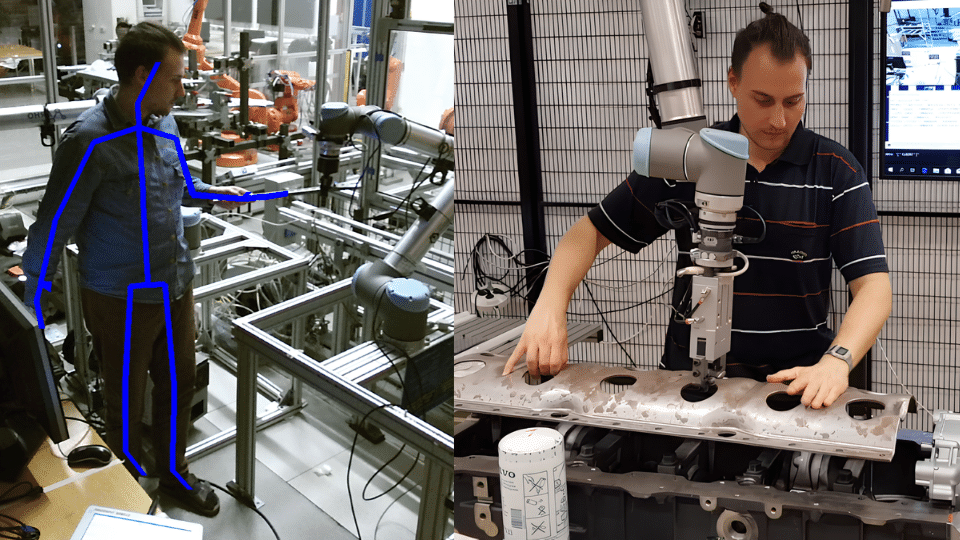
In another project, the team explored how collaborative robots could share workspaces and even tools with human operators. Unlike traditional industrial robots that operate behind safety barriers, these systems must continuously monitor their surroundings, understand where people are located and adapt their behavior accordingly.
Endre compares the technology to a self-driving car.
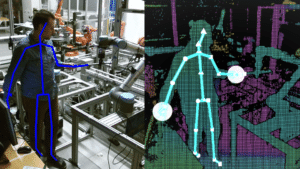
“The vision system acts as the car’s eyes, while planning and optimization algorithms work like the route planner. If something unexpected happens, it simply replans and finds a new way forward.”
In practice, this means a robot can monitor its surroundings, recognise where operators are located and adjust its movements accordingly. Rather than stopping when conditions change, the system can generate a new plan while continuing to work safely alongside people.
Why flexibility matters more than efficiency
For many years, discussions about automation focused on reducing costs and increasing productivity. Endre believes that perspective is changing.
“The biggest value is not necessarily in pure time or cost savings,” he says. “It’s making it possible to automate processes with high variation that have previously been too difficult or too expensive to automate.”
That flexibility is becoming increasingly important for European manufacturers facing shorter product lifecycles, growing customization demands and increasing competition. Rather than optimizing a single fixed process, companies increasingly need systems that can adapt when products, volumes or operating conditions change.
The benefits extend beyond productivity. Intelligent automation can improve ergonomics, reduce repetitive tasks and allow people to focus on work that requires human judgement and dexterity. For Endre, successful innovation is not about technology alone. It is about developing solutions that companies can actually adopt and benefit from in practice.
The role of Applied AI at Chalmers Industriteknik
While the technologies themselves are evolving rapidly, Endre sees Chalmers Industriteknik’s role as remaining constant: helping organizations understand how emerging research can solve real operational challenges.
For him, the most rewarding moments come when companies stop asking how the technology works and start asking what it can do for them.
“During the live demonstrations, visitors weren’t only asking how the technology worked,” he recalls. “They were asking how they could use it in their own production. That’s when I realized this wasn’t just an interesting research result, but something that could have a real impact.”
Through projects like these, the Applied AI team helps organizations evaluate, test and implement emerging technologies, turning promising research into practical solutions for industry.

Quench your thirst for knowledge with exciting reading
Be among the first to learn about new research in the areas of Circular Economy, Applied AI, Innovation Management, Energy, and Materials. In our newsletter, we share innovative techniques and projects that make a noticeable difference in society. You will also receive tips and invitations to interesting seminars and events within our field.
