Paving the way for advanced technology
In the quest for sustainable energy solutions, biomass has emerged as a vastly promising resource.
Through laser-induced graphitisation, the BioGraph-project transforms biomass into high-quality graphite and graphene, unlocking new opportunities for advanced technologies. Paving the way for a greener future.
It’s busy days at the Chalmers Industriteknik (CIT) office in Gothenburg. CIT heads or participates in 450-500 projects yearly and BioGraph is a special one.
The project explores a transformative idea, that waste and low-value biomass can be elevated into high-performance graphite through precision engineering.
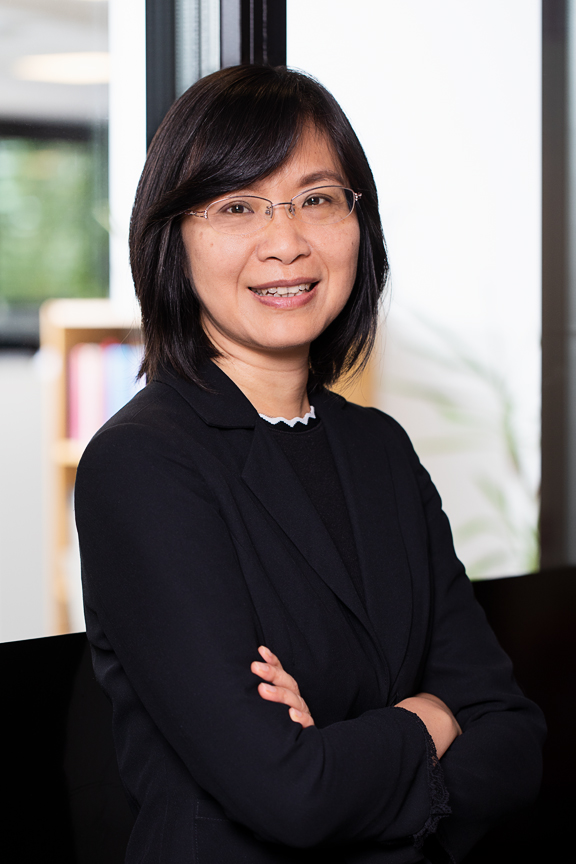
– By employing laser light to heat and carbonize and/or graphitize specific regions of biomass, we introduce an unprecedented level of control over the carbonization and graphitization process, explains Lilei Ye, project manager at CIT.

Sustainable efficiency
Within BioGraph, financed by the Swedish Energy Agency, the partners use laser light to graphitise biomass. This can then be used for energy storage and power systems in supercapacitors and batteries.
– Ultimately, the importance of this project lies in its convergence of sustainability, efficiency, and technological advancement. It challenges conventional assumptions about resource use and material production, demonstrating that greener pathways can coexist with performance and scalability, says Lilei Ye.
Traditional graphitization processes typically require extremely high temperatures sustained over long durations, resulting in substantial energy consumption and associated emissions. By contrast, the use of laser energy introduces a more efficient paradigm: energy is delivered precisely where needed, minimizing losses and enabling faster processing. This localized, on-demand heating not only reduces overall energy requirements but also opens the door to scalable, adaptable manufacturing systems.
– As industries and societies strive to decarbonize and build resilient supply chains, innovations like this point the way forward. Here, advanced materials are not extracted at great environmental cost, but grown, shaped, and refined through intelligent, sustainable processes, says Lilei Ye.
Market potential
As project coordinator, Chalmers Industriteknik provides the structural backbone that allows multidisciplinary collaboration to thrive. Bringing together expertise from materials science, laser processing, energy and sustainability, CIT ensure that each component of the project advances in alignment with shared objectives and timelines.
Also, as project communicator, CIT translates technical developments into accessible narratives that resonate with diverse audiences, from academic peers and industrial stakeholders to policymakers and the general public.
“Through strategic communication, we ensure that the project’s contributions are visible, understood, and positioned within the larger context of sustainable materials and energy transitions.”
– Lilei Ye
As responsible for exploitation, CIT focus on the pathway of the project’s outcomes, ensuring that innovation does not remain confined to the laboratory. A crucial step is to identify opportunities for scaling, commercialization, and integration into existing value chains, particularly in sectors where sustainable graphite alternatives are urgently needed.
– This includes engaging with potential end-users, evaluating market potential, and aligning the project’s technical developments with practical and economic realities. By proactively considering how the results can be adopted and applied, we help maximize both the impact and the longevity of the project, says Lilei Ye.
Important transformation
The BioGraph-project have made solid progress in establishing the foundations of the process. Appropriate raw materials have been carefully selected and derived from wood-based biomass, providing a consistent and sustainable precursor.
– These materials have subsequently undergone stabilization treatment to remove volatile organic compounds, ensuring structural integrity and improving their suitability for further processing.
Building on this, focused laser irradiation has been successfully applied to induce the formation of carbon. This step demonstrates the feasibility of using localized energy input to transform biomass into functional carbon materials.
BioGraph’s road from research to industry is a gradual and evolving journey rather than a single milestone. What has already been achieved, the successful selection and stabilization of biomass, and the demonstration that focused laser light can induce carbon, marks an important starting point.
– It shows that the core concept is not only scientifically sound, but also technically feasible. As the project progresses, the next natural step is to test this bio-based material in energy-storage system, says Lilei Ye.
Text: Jonas Löfvendahl
BioGraph facts
The project runs 2024-2027 and is funded by the Swedish Energy Agency as part of the Bio+ 2024 programme. The project partners are RISE, Ligna Energy, Percy Roc, STMicroelectronics Silicon Carbide, 2D fab and Chalmers Industriteknik.
Follow the project via LinkedIn, here!
Contact
Lilei Ye, Chalmers Industriteknik: lilei.ye@chalmersindustriteknik.se
Other views on the project
– It’s interesting to discuss what happens, from a purely physical perspective, in the complex zone where the biomass is heated and converted into graphite. It all happens in a matter of nanoseconds, where a mixture of gasified atoms forms graphite structures under extreme mechanical and thermal conditions, says Hjalmar Granberg, researcher at RISE.
“Laser-induced graphite could pave the way for sustainable electronics, from flexible sensors to energy storage components, all produced from renewable raw materials. We have progressed from basic experiments to reliably converting lignin into high-quality graphite.”
– Subimal Majee, researcher at RISE
Quench your thirst for knowledge with exciting reading
Be among the first to learn about new research in the areas of Circular Economy, Applied AI, Innovation Management, Energy, and Materials. In our newsletter, we share innovative techniques and projects that make a noticeable difference in society. You will also receive tips and invitations to interesting seminars and events within our field.